Is it legal to build an AI that explains legal documents?
Building an AI that explains confusing legal documents sounds helpful, and the thing most builders miss is that explaining a specific person's document can itself be the practice of law. In the US, advising someone on what their legal or immigration paperwork means, or how it applies to them, is the unauthorized practice of law when you are not a licensed lawyer. The wall here is not the AI. It is the act of interpreting a document for a specific person. A tool that only helps people fill in their own forms sits in a different and generally lawful place.
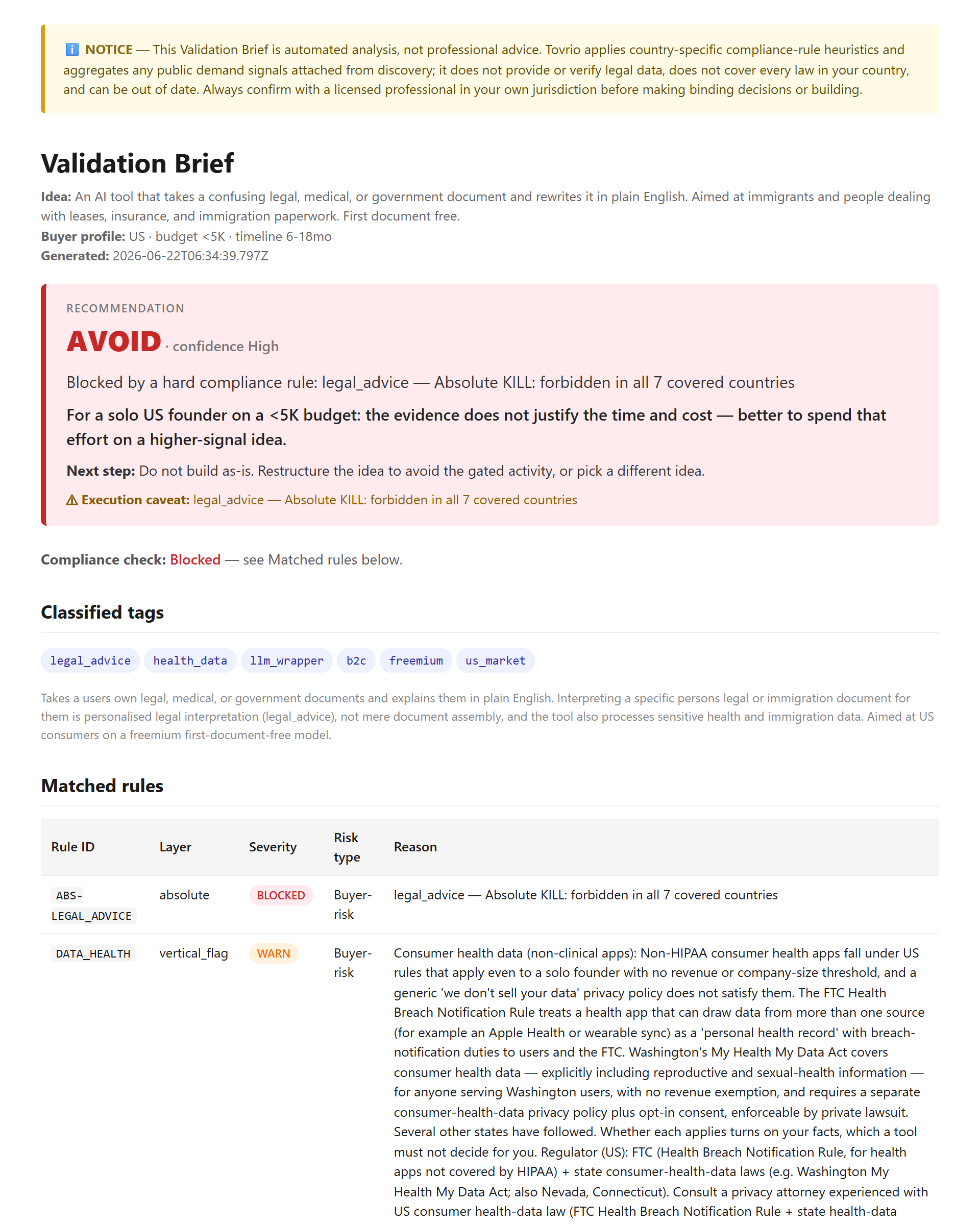
The card above is a real result from a compliance check. The idea tested was a synthetic example: an AI tool that takes a confusing legal, medical, or government document and rewrites it in plain English, aimed at immigrants and people dealing with leases, insurance, and immigration paperwork, with the first document free. The profile was a solo founder based in the US. The result was a blocked signal, not a needs review one, because interpreting a person's legal documents for them is an activity reserved to licensed lawyers. Two rules fired, and both are explained below.
Why explaining a legal document can be the practice of law
Practicing law is not limited to going to court. It includes advising a person on their legal rights and applying the law to their specific situation. When a tool takes someone's lease or immigration notice and tells them what it means for them, it is doing exactly that, no matter how the feature is labelled.
This is the assumption that trips up most legal-tech products. "It just rewrites the text in plain English" feels like a language task. Once the output explains what a document means for a specific person, it is legal interpretation, and in the US legal interpretation is reserved to licensed lawyers.
ABA Model Rule 5.5 does two things that matter here. It bars practicing law in a jurisdiction where you are not licensed, and it bars assisting a non-lawyer in the unauthorized practice of law. The unauthorized practice of law is defined and enforced state by state, and the definitions vary, but the through-line is the same: legal services are limited to members of the bar to protect the public from unqualified advice. A non-lawyer founder shipping a tool that advises the public can be on the wrong side of that line.
Source: ABA Model Rule 5.5, unauthorized practice of law.
The immigration trap: notario fraud
The idea targeted immigrants and immigration paperwork, which is the single most heavily policed corner of this area. In many countries a notario is a trained, licensed lawyer. A US notary public is not. Non-lawyers who use that confusion to advise immigrants are committing what the American Bar Association calls notario fraud, or the unauthorized practice of immigration law. The consequences for the immigrant can be severe, including missed filings, denied relief, and even deportation, which is why the ABA runs a dedicated project against it.
Federal rules reinforce the representation side of this. Who may represent or appear for a person in immigration matters is limited to licensed attorneys and representatives accredited by the Department of Justice, along with a few narrow categories. Giving immigration legal advice as a non-lawyer is the unauthorized practice of immigration law in its own right, which is the notario problem above. An AI that reads an immigrant's documents and tells them what they mean steps onto both.
Sources: ABA Fight Notario Fraud project and 8 CFR 1292.1, representation of others.
The myth versus what the law treats it as
| The common assumption | What the law actually treats it as | |
|---|---|---|
| A plain-English rewrite | Just translation, not legal work | Interpreting a person's document for them is applying law to their facts |
| Who can do it | Anyone with good software | Legal advice is reserved to licensed lawyers, defined state by state |
| Helping immigrants | A helpful service for people who need it | One of the most policed areas; non-lawyer help can be notario fraud |
| Adding a disclaimer | A disclaimer makes it safe | A disclaimer does not convert legal interpretation into a non-legal act |
The line the engine draws
The block is not on legal software in general. The engine separates two things that look similar from the outside.
Interpreting or advising on a specific person's documents, picking the right form for them, or reviewing their situation is the practice of law, and that is what gets blocked. A user-driven self-help tool is different. Where the user supplies their own information, makes their own decisions, and the software only assembles or formats a document, that is the LegalZoom or TurboTax model, and it is generally lawful in much of the US. Courts and statutes in several states have backed that self-help model.
That line is fact and jurisdiction specific. It is crossed the moment the tool picks the document for the user, reads their particular situation, or tells them what to do. Building on the lawful side of it is a product decision, not a disclaimer.
Why the medical documents also raised a flag
The same idea offered to rewrite medical documents, and that added a second, separate flag: consumer health data. A non-HIPAA app that handles a person's medical information can fall under the FTC Health Breach Notification Rule and a growing set of state consumer-health-data laws, and none of them have a small-founder or no-revenue exemption. A generic "we don't sell your data" policy does not satisfy them.
This one is a warning rather than a block, because handling health data is lawful with the right safeguards. It is still real work to price in: breach-notification duties, a separate health-data privacy approach in some states, and consent rules. The point is that one sentence in the idea, "medical documents," pulled in a whole second regime.
Source: FTC Health Breach Notification Rule.
If you are a solo founder on a small budget
The cost here is not the model or the build. It is that the core action, interpreting someone's documents for them, is reserved to licensed lawyers, and you cannot disclaimer your way out of it. That is why a compliance check returns this idea as blocked rather than as a manageable risk.
If that wall is too high for your stage, these are not workarounds. They are different products that move off the gated activity:
- Build a pure self-help tool where the user enters their own facts and makes their own choices, and the software only assembles or formats a document. Keep interpretation and recommendations out of it.
- Build for licensed lawyers or accredited representatives as your customer, as a tool they use under their own license, rather than advising the public yourself.
- Limit the product to plain-language education about how a type of document generally works, not advice about a specific person's document.
Each of these changes what the product actually does, which is what changes whether it is the practice of law.
How to validate before you build
The result shown above came from Tovrio, a compliance check that runs an idea against country specific rules before you write code. The idea tested was a synthetic case, not a real user. The result was a blocked signal with the reasons named here.
This is a validate before you build signal, not legal advice. A block means "do not build it this way without restructuring, or confirm it with a lawyer first," not "you personally will be prosecuted." You can run your own idea through it.
Frequently asked questions
Is it legal to build an AI that explains legal documents?
It depends on what the tool does. A tool that takes a specific person's legal or immigration document and tells them what it means for them is interpreting law for them, which is the unauthorized practice of law in most US states when it is done by a non-lawyer. A user-driven self-help tool, where the person supplies their own facts and makes their own decisions, sits in a different and generally lawful category. The line is whether you interpret and advise, or only assemble.
What is the unauthorized practice of law?
It is providing legal services, such as advising on someone's rights or interpreting how the law applies to their situation, without being licensed to practice law. Each US state defines and polices it, and the definitions vary. ABA Model Rule 5.5 also bars a lawyer from assisting a non-lawyer in the unauthorized practice of law, a duty that can reach the software company a lawyer works with.
Is explaining a document the same as giving legal advice?
Often yes. Telling a specific person what their lease, notice, or immigration form means, and what it implies for them, is applying law to their facts, which is the core of legal advice. Pure language translation with no interpretation is closer to a language tool, but the moment the output explains the legal effect of a document for that user, it edges into advice.
What is notario fraud and why does it matter for an immigration app?
In many countries a notario is a trained lawyer, but a US notary public is not. Non-lawyers who exploit that confusion to advise immigrants are committing what the American Bar Association calls notario fraud, also described as the unauthorized practice of immigration law. Federal rules limit who may represent or advise people in immigration matters, so a product aimed at immigrants sits in one of the most heavily policed corners of this area.
Are self-help legal document tools like LegalZoom legal?
Generally yes, where the user supplies their own information, makes their own decisions, and the software only assembles or formats a document. Courts and statutes in several states have backed that self-help model. The line into the unauthorized practice of law is crossed when the tool picks the document for the user, interprets their situation, or advises them on what to do. It is fact and jurisdiction specific, so confirm your model with a lawyer.
Does this apply if I am not a US lawyer or not based in the US?
Yes. These rules bind the service and the person offering it, not only licensed lawyers, so a non-lawyer founder anywhere who offers this to US users can be on the hook. Many other countries also police non-lawyer legal services, and some do so aggressively. Where your company is incorporated does not move the duty off your plate.
Run your own idea through Tovrio before you build. See how it works.